

Waterfowl hunters love layout boats
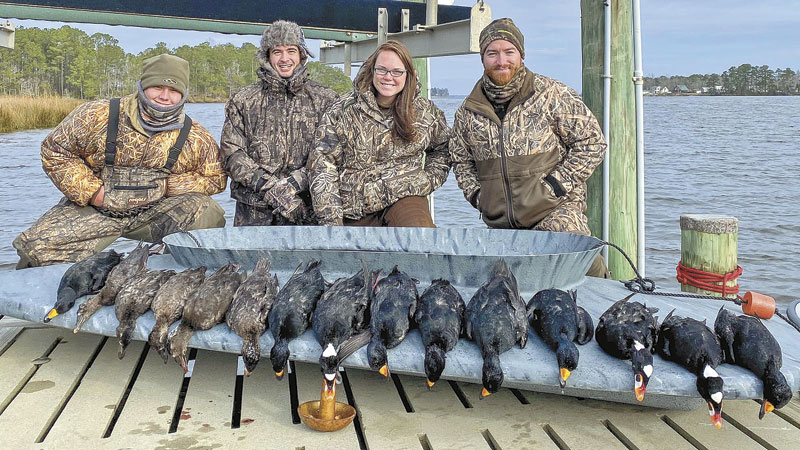
Sea ducks make for some of the most fun hunting to be had, but they can also be some of the toughest birds to take. These tenacious waterfowl are notorious for hitting the water after what seemed like a successful shot and then diving and swimming away. Coupled with the large bodies of water they frequent, it’s easy to lose a crippled duck if you’re not careful.
Thankfully, there’s a tried-and-true item that can set you up for incredible in-your-face shooting action.
Hunters have been using layout boats along the Carolina coast for centuries. These formerly wooden boats were part of what enabled market hunters to be so successful, as they rode low in the water and allowed gunners to ride right above the waves and in amongst the decoys for close shots with their punt guns.
Back in those days, the decoys were often attached directly to the layout boats via a long wooden fringe that encircled the boat and rode just under the water to make it appear that the decoys were floating. Some things have changed — modern layout boats are made of polymer, often resemble an elongated spittoon instead of a box, and the dekes are just placed near the boat instead of being attached to it. But the premise is still the same: put hunters as close to the ducks as possible to give them the greatest chance at a successful hunt.
How it works
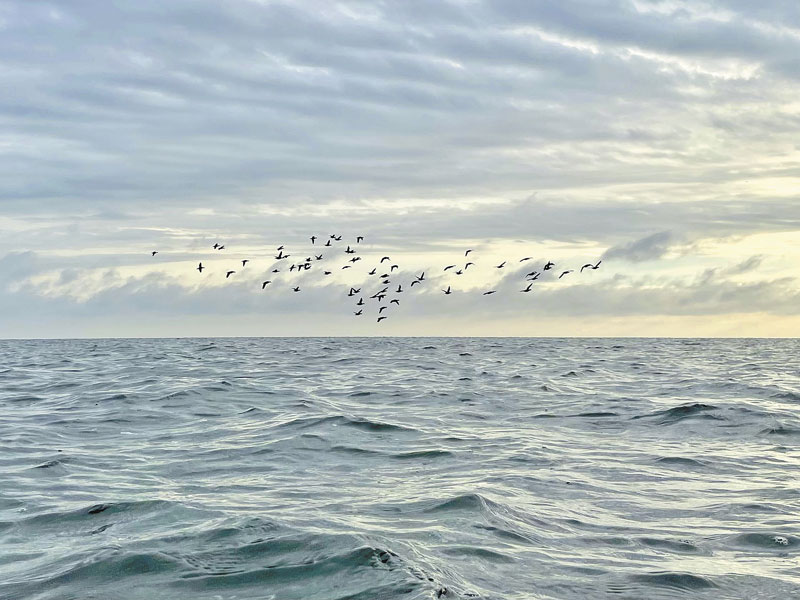
Hunting for sea ducks from layout boats is Jay Boone’s specialty. Boone is a waterfowl guide headquartered in Morehead City, NC. Guiding with B and B Waterfowl (252-725-7777), he has decades of guiding experience under his belt. He keeps his decoy spreads fairly small and simple compared to what is often employed for sea ducks — 16 to 32 individual dekes versus long lines of hundreds of decoys.
Boone’s strategy is to put in the time and scout a location to find out where the sea ducks are frequenting and then place his hunters in layout boats before motoring off to a safe distance. He’s their “retriever,” waiting for the hunters to fire and then returning to scoop their birds off the water.
Layout boats are remarkably safe for the hunters — and remarkably comfortable. While the boats are relatively lightweight and seem like they could be tossed around by every wave, an anchor at the head of the boat and another at its foot keeps the boat and its hunter steady and stable in all but the worst hunting conditions. Boone advises his hunters to wear waders regardless of the conditions. But layout boats by no means make for a soggy ride with waves pouring over the bow.
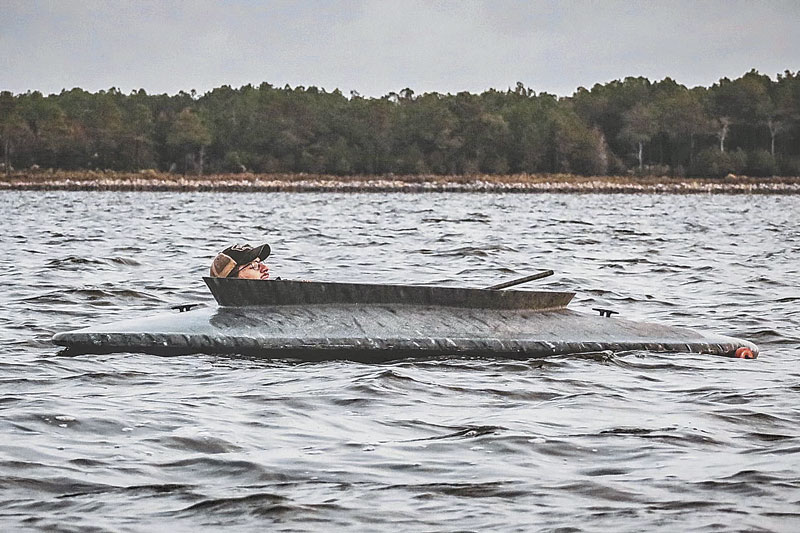
Likewise, a folding backrest keeps the hunter in a laid-back position with their head just above the layout boat’s lip. They can scan the horizon and then rise enough to shoot when needed. It’s a no-frills boat, but such measures, coupled with the typically short time needed to draw ducks in and fill a hunter’s bag limit, make it easy to relax while you wait.
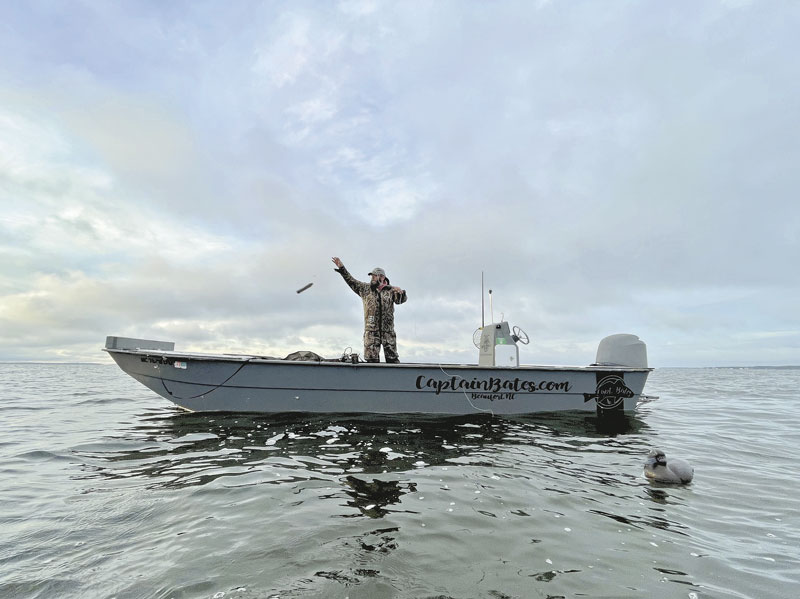
Boone recommends a shotshell/choke tube combination of 3-inch shells of steel No. 2s fired through a modified choke tube. This pellet size and constriction gives you a good pellet density across the pattern and keeps the overall shot fairly tight. This, in turn, lets you hit individual birds when they fly to the spread rather than shooting into the flock and downing more birds than your limit allows for — or crippling birds instead of killing them immediately, as mentioned earlier.
Precision shooting
This is especially important because sea duck levels have been dropping in recent years, resulting in lower and lower bag limits each season. For instance, hunters in North Carolina were only allowed four sea ducks in the 2022-23 season, and only three of those could be scoters or eiders or long-tailed ducks.
Biologists aren’t sure what is causing these population declines. Sea ducks are hard to survey given their habitat. But changing weather patterns don’t help. Boone said the species that used to arrive in North Carolina in the mid-season are now coming south deep into the late season because the temperatures are still fairly warm in the former.
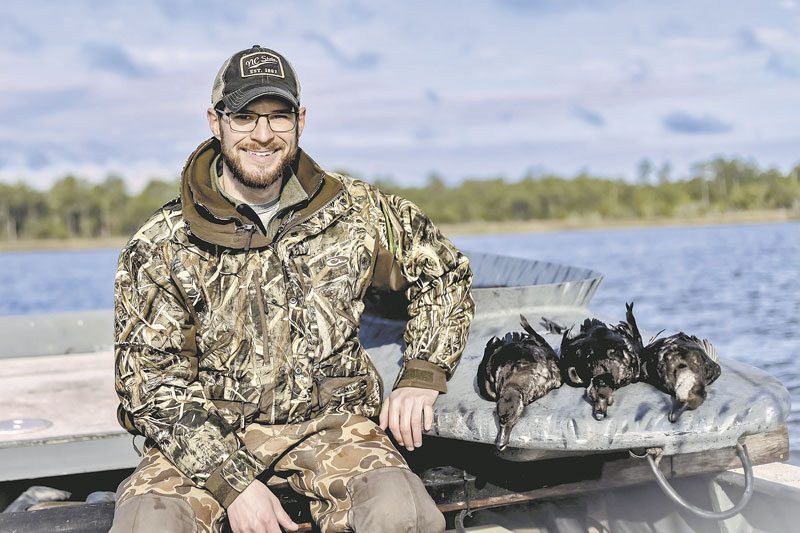
Still, Boone knows how to maximize the opportunities his hunters are afforded when the ducks do arrive. A successful hunt can last minutes, not hours — something that helps make it easy to introduce friends or family members to the sport without burning them out via long hunts for just a few birds. Boone’s two-person layout boats help with that, too.
Fledgling hunters really are in for a treat when the birds show up to a spread, as are seasoned hunters who may have only hunted ducks on small bodies of water before. Sea ducks, as diving ducks, take off from the water in long, splashing efforts instead of the near-vertical style of mallards and other dabblers.
Once airborne, sea ducks often remain low to the water as they cruise from spot to spot. Sky-blasting isn’t usually even a temptation, as the birds come roaring toward the layout boats from just feet off the surface and, given the right wind and setup, straight into reach of the guns.
From there, it’s just a matter of making your shots count.
Core Sound Layout Boats
Hunting from layout boats has long been a part of Terry Rose’s life. He’s the builder of Core Sound Layout Boats, a company located in Newport, NC and named after Core Sound, located in the Harkers Island area where Rose grew up.
These are some of the more popular layout boats used by sea duck hunters from the Carolinas to Alaska. Rose builds two basic models, including a one-man layout boat and a two-man layout boat. The two-man boat features an extra-wide hull, allowing the two hunters to lay side-by-side.
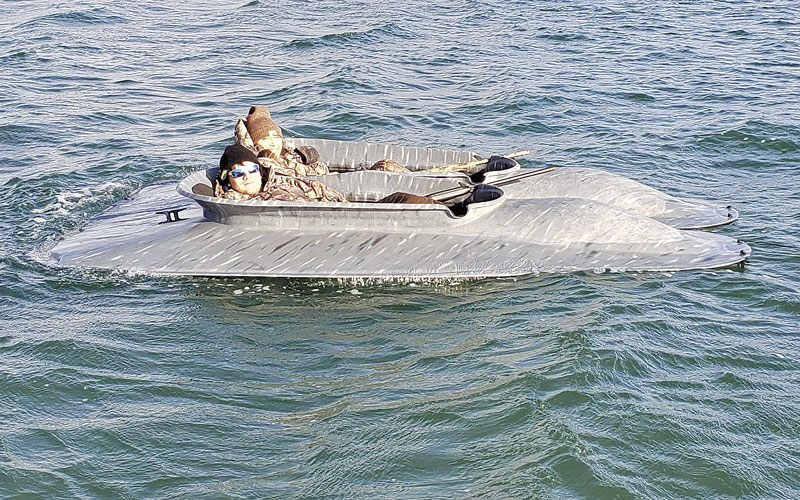
Among the unique features of these boats is the downturned flange, which helps keep spalshing waves out of the boat and hunters as dry as possible. Another unique feature is an oversized hump, giving hunters more foot room.
Rose began building boats professionally when he was 19-years-old, and has worked with several major fishing boat manufacturers over the years. About 20 years ago, he began building layout boats. He mainly did it out of frustration that came about from hunting impoundments and never being able to reach ducks that landed, then stayed, in the middle of them. His plan worked, and as he began learning more about waterfowl hunting in the open sea, he tinkered with different designs until he found what gave hunters the best on-the-water experience.
“Comfortable, dry, and safe. That’s what these boats are designed to be,” Rose said, adding that they are light enough to be handled easily, and they last generations.
Each one-man layout boat takes Rose about 30 hours to build. Each two-man model keeps him busy for more than 40 hours.
Be the first to comment