

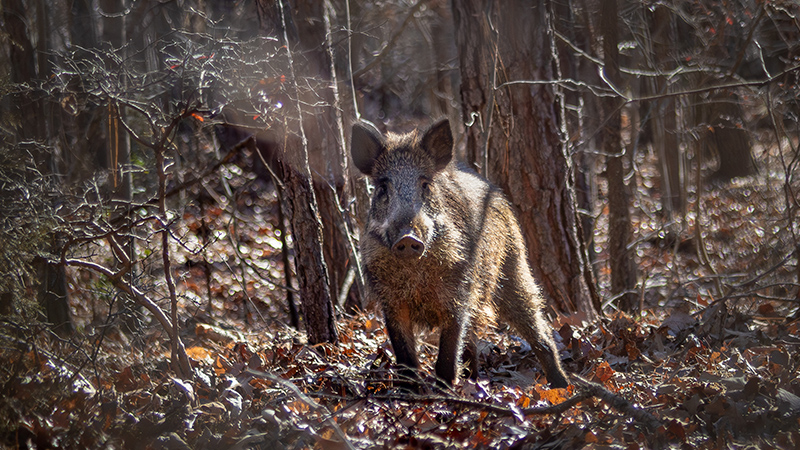
Wild hogs are a growing problem throughout the south
There’s an old saying: if you see one roach, you have a roach problem.
Same with wild hogs.
These critters are omnivorous, opportunistic, awesomely destructive, super-survivalist, perpetually-procreating pains in the Boston butt.
On the other hand, Sus scrofa can be hunted legally year-round in South Carolina, so they can be fun to have around. But for many deer hunters, their welcome mat is wearing thin.
On one 150-acre tract in Fairfield County, the owners, who’ve hunted the tract for four years, say the change since the porkers’ arrival has been dramatic. The property, which is primarily planted pines in the 5-year-old range, plus a mixed hardwood creek bottom, offers good cover and food for deer, turkey, quail, small game…and hogs. There’s also a sizeable population of coyotes, and a few bobcats.
Hog numbers go up, deer numbers go down
The hunters’ interest has remained mostly with the white-tailed deer herd. Four years ago, the herd was healthy. This was evidenced by the many trail cams placed on the five food plots. A good mix of does and bucks of various ages showed up on a regular basis. Despite the healthy herd, the three hunters chose to harvest only three does in the first season.
The following spring, the first porkers showed up on camera. At first, this was greeted with excitement. But the hunters soon learned that the pigs required different tactics, including an investment in night scopes. Still, the hogs were elusive and most managed to dodge the hunters.
Rather than thinning numbers, the trail cams showed an alarming increase in the quantity of pigs. A homemade trap of sorts was built with a circular fence and trapdoor with a constant food source of shelled corn and protein pellets. The hogs quickly figured out the ruse and left the free meals to spoil in the trough.
As another year passed, the hunters noticed a rather unsettling transition of trail cam images. Whitetail numbers were steadily going down around feeders and food plots. At the same time, hogs were showing up, night and day, in ever-increasing numbers. And unlike the random hogs of the previous year, entire family units were arriving. A couple of sows and boars along with several piglets became the norm for a late evening dinner group. After deer season ended on Jan. 1 and hunters cleared out of the woods, hog sightings increased dramatically.
The deer hunting went downhill fairly rapidly and by the most recent season, deer sightings in plots, crossings and feeders were down to near zero. Hogs on the other hand continued to proliferate.
Partially productive
Night hunting with thermal scopes for hogs became a secondary activity, but proved to be only partially productive. Hogs tend to move in groups, or sounders, and if there are 12 together, 10 or 11 will likely escape after the first shot.
Something else the hunters began to notice on the photos; the little pigs grew up fast. Five-pounders appeared to became fifty-pounders in what seemed like a matter of a few weeks. And no sooner had they left the nest than a new family unit would show up, complete with mom, dad and ten or twelve cute little wiggly pigglies.
It was then they realized, despite their high hope for a good neighbor policy between the deer and hogs, there could be no peaceful détente between the two species. And while whitetails are no wimps, with sharp antlers and powerful hoofs, the pigs are far more aggressive, with teeth and tusks and an appetite that includes almost anything this side of a concrete block. Even newborn fawns.
It seems the deer have moved to friendlier territory, and the turkeys have departed as well. Their nests of eggs and poults make an easy meal for the ground-feeding hogs.
Trapping
So, what to do? For the deer hunter, turkey hunter, quail hunter and farmer, wild hog expert Andrew Jamison recommends trapping.
Jamison, a Wildlife Damage Associate with the Clemson Cooperative Extension, is well-studied in the ways of wild hogs in our state. They are scattered across every county of the state and have shown no signs of stopping. When asked how they seem to be so adaptable to most any type of terrain, Andrew says they simply have a survivor mindset.
“They’re very adaptable and eat most anything that’s even the least bit edible,” explains Jamison. “For hunters and other outdoorsmen, that becomes a problem. To try to cut down on the population you’ve got to really single out the females. If you see 4 females and you only shoot two of them, the other two will soon breed, to make up for their losses.
“As far as the competition with deer goes, both species love acorns. Unfortunately, the hogs tend to eat most of the acorns and chase off the deer at the same time. They’re just naturally more aggressive. Also, sows have a lot of offspring, up to eight to 10 piglets in two or more litters per year, while the doe will have one or two fawns in a year’s time.
According to Jamison, trapping is definitely the most effective method for controlling hog numbers, and there are several types to choose from. Once trapped, he recommends dispatching the animals with a .22LR to the head. “We need to show them some respect,” he says. “There’s no reason to make them suffer.”■



Be the first to comment