

Many anglers start their fishing careers in farm ponds
The words “farm pond” and “crickets” bring back fond memories of many childhood afternoons sitting on a dock holding a homemade cane pole with a line, bobber, and hook attached. When leaves begin to swell with new growth on trees and shrubs, it’s time to start fishing. My definition of a farm pond is any size body of water big enough to hold a fish but not considered large enough to be called a lake or reservoir. It could be anything from a pothole in the middle of a southern soybean field or one nestled deep in the woods.
This March has been unusual with roller-coaster temperatures. Finally, last week they briefly steadied around 75 degrees F, and it was time to hit the farm pond before the temps dropped again. No matter how warm it gets, the temperature will dip back into the freezing range until Easter arrives. Couple the warm weather with daylight saving time, and you have the perfect recipe for a farm pond fishing afternoon with some of my favorite people.
Kids of all ages
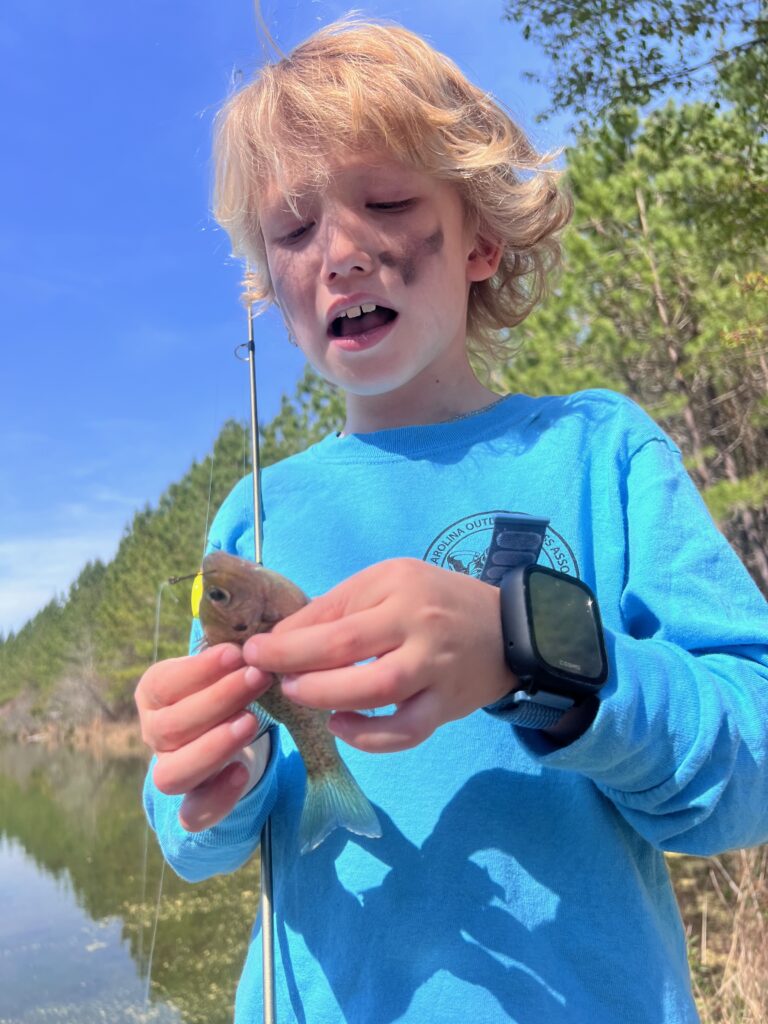
Before I could even mention a fishing trip to them, Drew and his son, Rivers, invited me to come along and fish a small pond below Orangeburg, South Carolina. It seems their mindset was the same as mine. The weather window of opportunity would only be open for a few days, so the three of us needed to make the most of it. Sometimes mothers don’t understand the importance of combining weather and fish, so we waited until the weekend, when children are out of school to go fishing.
Saturday, being the last warm day before a severe cold front would envelope us for another week, it was decided to keep fishing simple on our first outing of the year. We wouldn’t need a lot of gear, just a few rods and supplies, and bait.
Keep it simple
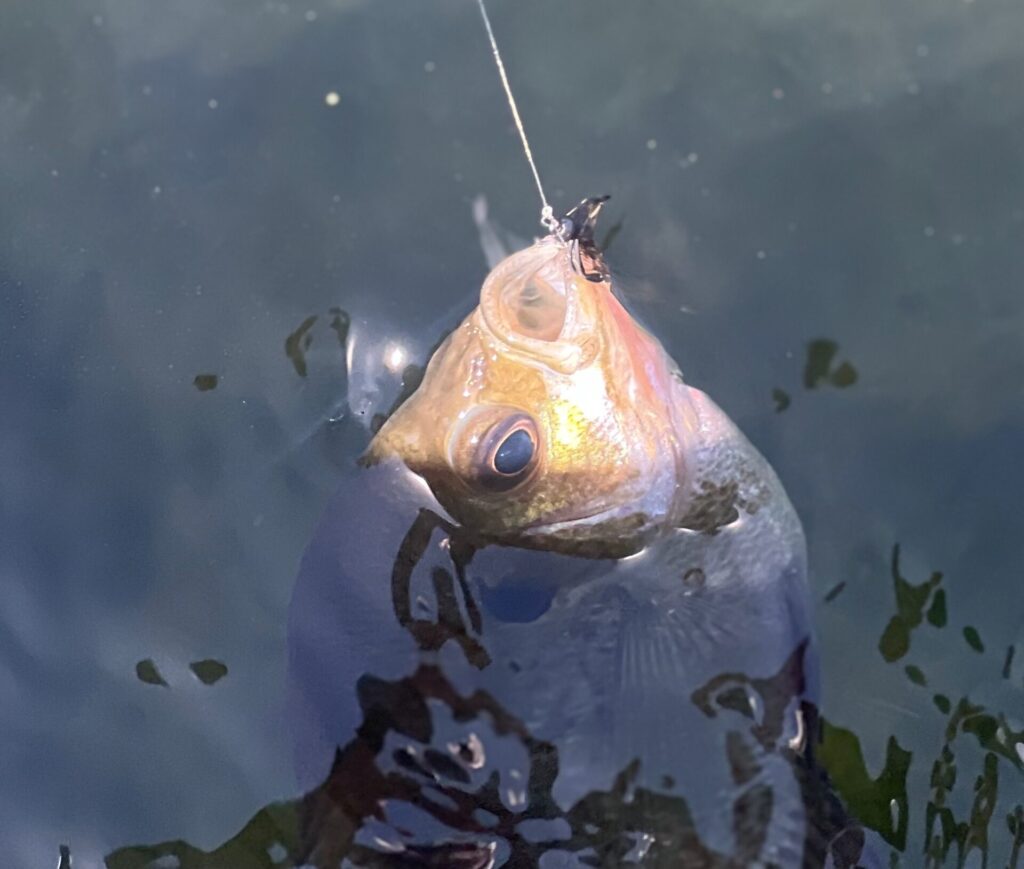
“What bream could refuse a big, juicy cricket?” I thought. “Let’s not over-complicate this trip.”
Heading through rural South Carolina, I noticed many fields had been burned, giving the area a scarred look. The surrounding woods were barren except for the maple trees and their maroon fingers of new growth. Everything would be green again soon. Drew, a forester by trade, stated these were one of the first trees to bear leaves in spring. Their reds against the forest’s gray and browns marked a time for new beginnings.
Hunger and bait forced us to stop at an old grocery and gas station to satisfy both. We purchased fifty of the liveliest crickets the store had. Actually, it was the only live ones left in the cage. Then we grabbed a healthy meal consisting of a hamburger and fries to continue our journey. Rivers wanted to be the keeper of the crickets and was instructed not to let them loose in the truck like last time. Drew laughed and said he could hear them chirp under his seat for weeks.
As a young boy, I can remember grabbing a few hooks, weights, and a bobber from dad’s tackle box, stuffing them in my pockets, grabbing the bait, and going fishing. That’s the simple way farm pond fishing should be. Before leaving the house on this morning, we followed suit by grabbing only a package of size 8 bait hooks, needle-nosed pliers, split shot, three ultra-light spinning rods, and two cane poles. Never leave to fish a farm pond without those ubiquitous red and white bobbers. Today, there would be no baitcasting rods, no tackle boxes full of crankbaits and spinnerbaits, or soft plastic worms.
Vivid memories
Drew turned off the paved highway and headed down the old logging road towards the pond. We were almost there when Rivers began telling us about several big fish he had almost caught at this pond last year. He became excited as he recounted stories about losing Beetle Spins on feisty fish, until his dad reminded him that those were brush piles that took his lures, not fish.
Looking at him, I said in agreement, “I believe you. Those big fish are smart and probably entangled you in the brush pile trying to get loose. It happens to all of us.”
“If you keep fishing long enough, you will catch and land a big one,” I continued. “Remember, bigger bait means bigger fish!” It’s important to teach young people how to enthusiastically stretch a non-fiction fishing story.
Once in the little boat and motoring around the pond dam towards the spillway, it was interesting to watch Rivers stick his hand into the cricket bucket and gingerly bring out a single cricket pinched softly in his fingers, and suddenly find another one attached to the back of his hand. In one fluid motion, he dropped the cricket held in his fingers and caught the loose one. Finally, he managed to hook the cricket and cast it over to a fishy-looking spot. I was proud of him not flipping the cricket off the hook as he cast the little open-face spinning rod towards the weed line. That marked a true sign of maturity in fishing.
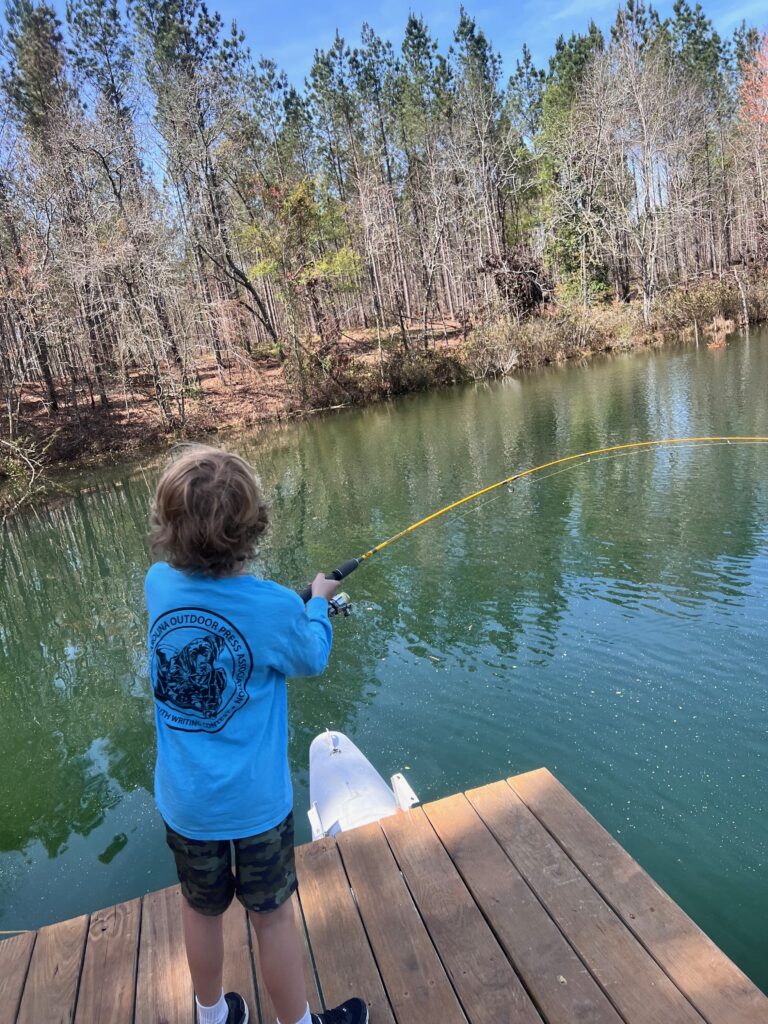
Quickly, he hooked a small bass. His first instinct was to jerk the little rod hard and then turn the reel handle as fast as possible. The little ultralight rod would bend almost to the cork grip. Rivers grit his teeth and focused on getting the fish to the boat as fast as possible. After catching a couple of little bass, he finally slowed down on the winding, relaxed, and started feeling the fish surge and pull back. He mentioned how good it felt when the fish tried to yank the rod from him. I think he was finally discovering where the fun lies in catching them. Watching children catch fish is priceless. Our intention was to catch bream, but in a farm pond, it becomes a matter of whatever bites is the winner. It didn’t take long to realize bass like crickets, too.
The pond water was extremely cold, making the fish lethargic and less prone to bite. The afternoon sun felt great as it baked down. After the brutally cold winter, it was almost hot. Questioning us, Rivers asked if we had used sunscreen as he did. Our negative remarks launched an interrogation from an eight-year-old, which I won’t discuss.
Before moving around the far side shoreline, we found it necessary to drop a few crickets around some deep-water brush piles. The water was still translucent and clear, with visibility extending almost 10 feet down. Several large bass could be seen below, swimming in and out of the brush piles, but they didn’t appear hungry. Rivers decided our crickets didn’t have enough action and weren’t jumping enough underwater, so it was time to replace them. Why argue with an expert? We rebaited with fresh ones, but that didn’t work either. Nothing seemed to be working consistently after Rivers caught the first couple of fish near the spillway.
Quietly, we three fished around the shoreline, stopping to fish every set of fallen logs and stumps, when suddenly, a hen turkey cackled over the ridge, her voice echoing across the small body of water. We listened to her cajoling the woods for a gobbler while quietly explaining to Rivers what he was hearing. She sounded desperate, but with no resounding answer from a gobbler, she moved on. Drew memorized that spot and told her he would be back in a few weeks to find that quiet gobbler lurking nearby.
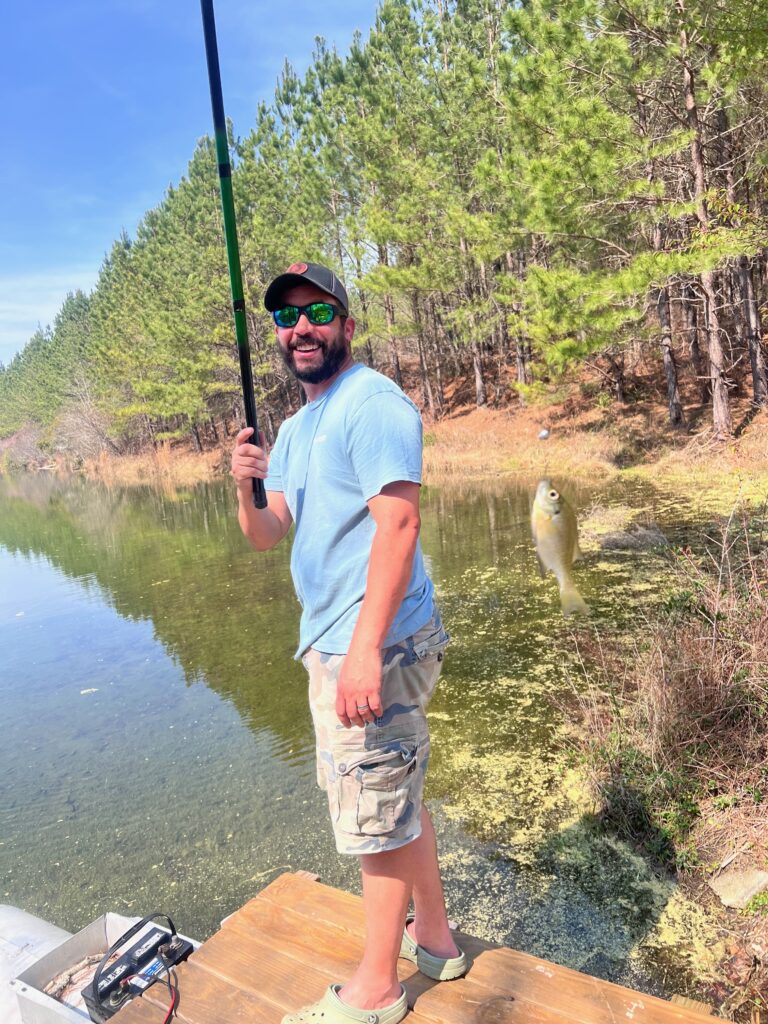
Rivers managed to catch a few small bream near a large, water-soaked tree trunk and had numerous hook-ups that ended in frustration.
I told him, “Those were probably small fish with tiny mouths, and we wanted to only catch fish that could eat an entire cricket instead of nibbling on it.”
“That’s right, big bait for big fish. I remember now,” he said. Then he sat down and reached into the cricket bucket, began sorting crickets, and rebaited his hook with a bigger one.
With little effort, the trolling motor maneuvered us back around towards the landing. Evidently, the big cricket theory had some degree of validity. He managed to catch two of the biggest bass we landed all day. We decided the big bream must still be schooled in the deeper water around structure. Some small ones finned in the shallow, but nothing bigger than hand size ever bit. We estimated that it took over thirty crickets to catch four bream and three bass. The laughs and fellowship made up for the difference in the number of fish caught.
Rivers and I emptied the remaining crickets in a shallow cove, causing a brief feeding frenzy of small fish. He looked at me, somewhat bewildered at all the commotion. We watched one cricket swim across the surface and a tiny bream mouthing it but couldn’t quite eat it whole.
Then Rivers looked up and said, “Small bait, small fish,” and I smiled.
The solitude of a farm pond, the placid water without wakes and noise from others, and the simplistic method of fishing on an early spring afternoon composed a good ending to the week. The enthusiasm and joy of fishing with Drew and Rivers were contagious, and the time spent together passed too quickly. Despite the slow fishing, the three of us had a grand time. Early warm afternoons, family fishing, and farm ponds have a deep connection. ■
Be the first to comment