
Pisgah National Forest is home to wild brown trout
Fishing for wild brown trout in the Pisgah National Forest is a bit like playing hide and seek. Crouching low behind streamside boulders is often crucial in tricking one of these fish into biting.
And hiding from people, or at least hiking in to areas you’re not likely to see any, is just as much a part of it.
Chris Douglas of Carolina ALL OUT learned this while tagging along with Chris Wood, a fisheries biologist and planning coordinator with the NC Wildlife Resources Commission for an early fall outing.
The trip started with a 3-mile hike. The two then set up camp before checking out some likely fishing holes.
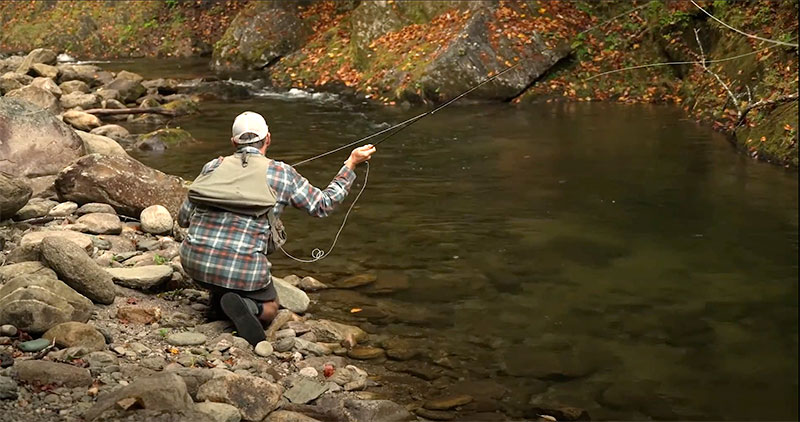 And the word “holes” can’t be overemphasized. This time of year, these backcountry streams haven’t seen rain in a while. They are more like a collection of small pools big enough to hold a few trout, with a combination of boulders and trickles of water in between each pool.
Low and slow
“These pools are very low and slow right now. We don’t have a lot of flow,” said Wood. “This is sneak attack fishing. We’re gonna have to be on our knees and hiding behind rocks.”
Wood said limiting your casts is also important.
“We need to make accurate, and very few, casts. We don’t want lots of false casts. We want to be casting straight to fish that we see rising,” he said.
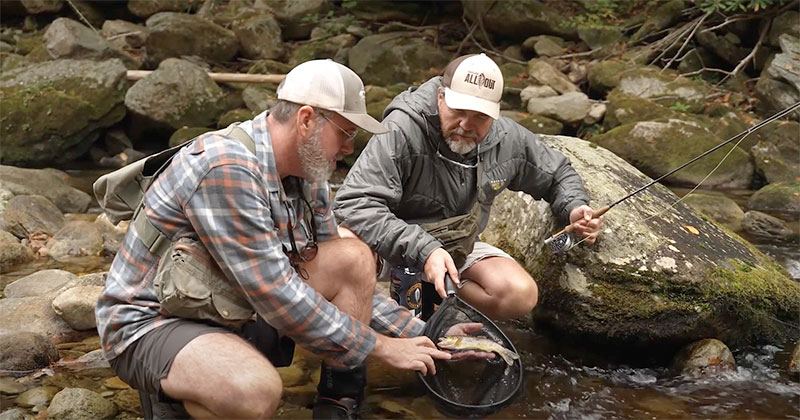
And right after saying that, Wood followed his own advice, which led to a quick hookup with a wild brown.
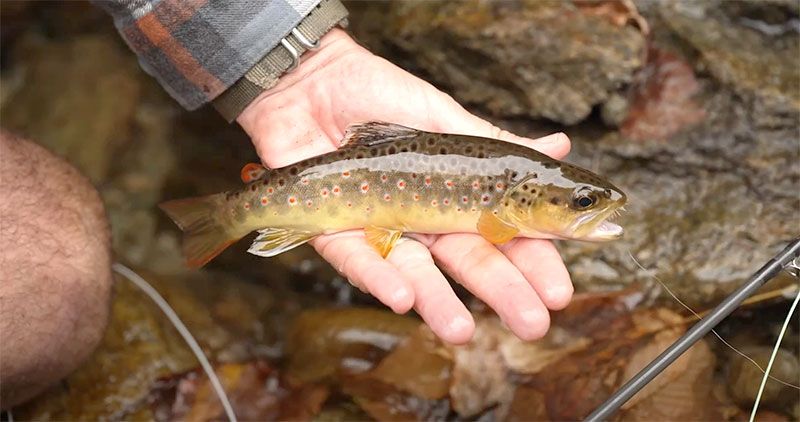
“This is an average-sized wild brown trout here,” he explained to Douglas while holding the 6-inch long fish. “This is what you’re going to get your numbers on.”
 The small size doesn’t make it any less of a trophy. A wild brown trout is a catch-of-a-lifetime for many folks, even for many Carolina fly anglers who don’t venture off the beaten path the way Douglas and Wood did to reach this spot.
And bigger wild browns certainly do patrol these waters.
“We’ll catch a lot this size. And we should see some in the 8- to 10-inch range. And if we get one up around the 12-inch range, that’s a trophy fish in here,” he said.
But no matter the size of these fish, the entire experience is more than worth the work it takes to get here.
Don’t overlook them
“That’s why we’re here. It’s why you hike 3 miles down to get away from everyone,” Wood said while holding a wild brown that Douglas caught.
The two also talked about how easily someone could walk right past these waters without knowing these fish are here.
“These are beautiful brown trout,” said Wood. “And they are loaded in here.”
Douglas talked about what these small, wild fish have to do in order to survive.
“It’s really an amazing animal,” he said. “You wouldn’t even imagine that something could be living in there. But, they’re here.”
 As day turned to evening, the two headed back to their camp, made up of hammock tents, and relaxed by the fire while reminiscing about the day’s events, and looking forward to a full day of fishing the next day.
Go dry
Dry flies are good bets here this time of year. Wood likes to start the day off with a dropper rig, which consists of a dry fly and a nymph tied to the same leader. The dry fly doubles as a strike indicator for the nymph, but sometimes, the fish ignore the nymph and go straight to the dry fly.
When that happens, Wood reties with just a dry fly to avoid some of the hassles that can come with the dropper rig.
Try the tenkara
Because casting here generally doesn’t require a lot of distance, Wood said tenkara rods are also very effective. These rods don’t have a reel, so it’s a bit like using a cane pole. Landing a fish involves lifting the rod tip as high as possible to bring the fish close enough to land.
Hiking in limits what an angler can bring, so Douglas asked Wood to talk a little about the essentials.
Wood suggests going on the smaller side with fly rods. A 7 1/2-foot, 4-weight is about all you need, he said. Anglers can go shorter and lighter, but he suggests not going longer or heavier.
He also suggests leaving the waders at home. The water temperature doesn’t require it this time of year, and it’s a great way to keep the weight of what you’re hiking with to a minimum.
“I like to wet wade. So I wear tall wading boots with felt soles to avoid slipping on these rocks,” he said.
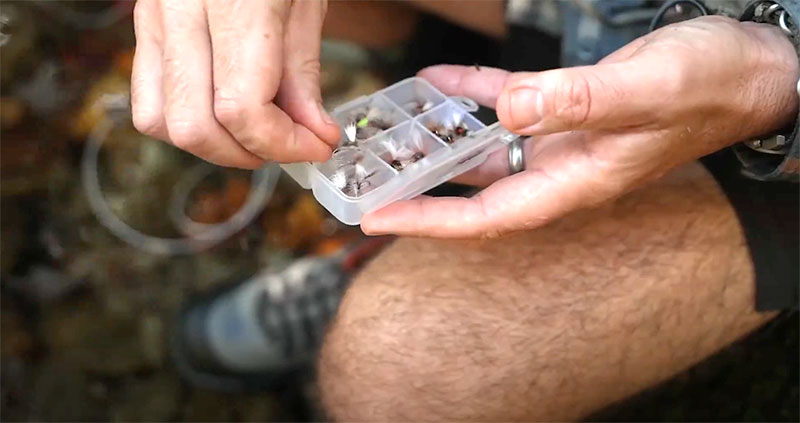
 He also urges anglers to wear neoprene booties to keep your feet in good shape. A fishing vest or a hip-sack is plenty to carry your flies and other gear while fishing, and packs up nicely for hiking in and out.
Fish it, drink it
Another way Wood saves on weight is he doesn’t haul any water with him. Instead, he brings a water filter and drinks straight from the streams.
“Keeping things light and simple is the way to go,” he said.
Douglas summed up this style of fishing by saying it’s simply fun and well worth the effort it takes to get here.
“I love this type of fishing, and you should try wild trout fishing here in western North Carolina. Really, there’s nothing like it,” he said. “It’s worth it all to catch these little guys. And you can’t deny, even though they are small, they are fun, and just the effort of getting here, catching them makes it all worth it.”
If you’d like to plan a backcountry trout fishing trip in western North Carolina, a good place to start is the NCWRC’s website at ncwildlife.gov/fishing/trout-fishing-north-carolina.
Be the first to comment